
An excerpt from the booklet essay by Jonathan Owen
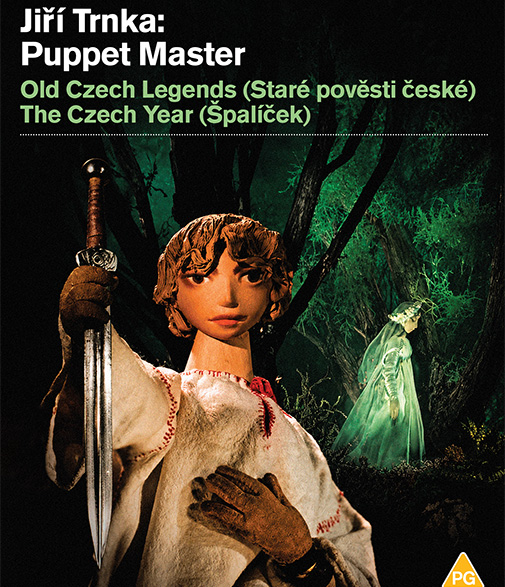
The Czech Year and Old Czech Legends are two groundbreaking works by Jiří Trnka, one of the most revered and influential figures in animation history. The Czech Year was the first animated feature film made in Czechoslovakia, a triumphant experiment in the expressive possibilities of the puppet film and an unconventional symphonic narrative of shifting seasons and moods. Old Czech Legends, produced five years later, was an unprecedented elevation of the puppet film into a vehicle for epic drama and national founding myth. Brought together here in new restorations, the two titles are something of a yin and yang of folkloric art, the first film breezier, homelier, more vibrant; the second darker, more grandiose and ethereal. Both, in their different ways, remain enchanting and superlative examples of Trnka’s art.
It is customary to refer to Jiří Trnka as the ‘Walt Disney of the East’. The label is imprecise, even misleading – Trnka’s methods were artisanal, his magic of a more nuanced, ‘adult’ nature than Uncle Walt’s – but it does capture his foundational and pioneering status. Considered the first animator to properly break Disney’s international supremacy over the medium, he established a style and sensibility that helped turn post-war Czechoslovakia into a renowned powerhouse of animation. His influence spread far beyond his home country. The popular stop-motion productions of Manchester’s own Cosgrove Hall studios were made by self-described devotees of Trnka, while other animators like Yuri Norstein, Henry Selick and Rebecca Sugar have claimed him as an inspiration.
Born in Plzeň in 1912, Trnka showed early artistic flair and was already making and performing with puppets as a child. At school his art teacher was Josef Skupa, the legendary innovator in Czech puppetry, who acted as an early mentor. While studying at Prague’s Academy of Applied Arts Trnka assisted in the creation of puppets for Skupa’s stage productions, and in 1936, he launched his own puppet theatre. The theatre proved financially unsustainable, which compelled Trnka to apply his talents to designing stage sets and costumes and illustrating children’s books (in which latter field he would prove a prolific master). It was as a costume designer that he broke into the world of film, but in 1945 he was chosen to lead the newly founded Trick Brothers animation studio. Here he created his first shorts, using drawn animation techniques. Trnka already attracted great acclaim with this work, which includes the striking satire Springman and the SS (1946) and the self-reflexive The Gift. But he felt unsatisfied working with drawn techniques and so in 1946 he left the Trick Brothers to form the Puppet Film Studio (Studio loutkového filmu).
In his new, cramped studio space, Trnka embarked on the series of shorts that together formed The Czech Year. Apropos of this film and its immense achievement, Antonín and Mira Liehm write: ‘when public funds and the free development of talent meet, they can bring success to public filmmaking in a small country where no immediate return on the production investment can be expected.’ This is true of Trnka’s work in general, all of which was made in a state-funded film industry that had been nationalised in 1945 and of course continued as such when the Communist Party took full power in February 1948. After the international success of The Czech Year, Trnka’s reputation only grew with the stunning, innovative and varied work that followed. His next film was the exquisite Hans Christian Andersen adaptation The Emperor’s Nightingale, which was released in France with a commentary written by Jean Cocteau and in the US with narration by Boris Karloff. His puppets performed an array of genre turns in such shorts as the atmospheric Gothic tale The Devil’s Mill (1949), charming Chekhov adaptation Story of a Double Bass and the funny but authentically action-packed Western parody A Song of the Prairie.
The epic Old Czech Legends was a milestone in both Trnka’s work and animation in general, not least in its use of puppets to portray individualised characters. Trnka took this individualising capacity even further in three short adaptations of episodes from another key work of national culture, Jaroslav Hašek’s novel The Good Soldier Švejk. The puppets were now ‘one step’ away from replacing ‘living actors’, observed critic Jaroslav Boček, who judged Trnka’s Švejk the most successful film version of Hašek’s book. On all his films Trnka acted at once as visual designer, screenwriter and director (on his first two features he also served as co-editor), though he benefitted too from the talents of such recurring collaborators as animator Břetislav Pojar, writer Jiří Brdečka and composer Václav Trojan.
Jonathan Owen's complete essay, from which this excerpt is taken, appears in the booklet which accompanies the release.

Blu-ray Reviews
Sight and Sound
Mondo Digital
Cinemas Online
The Geek Show
The Arts Desk
What's In A Scene?
Close-Up Film
Blueprint Review
London Grip
Jeremy C.
Film Reviews
The Czech Year
Film at Lincoln Center
Letterboxd
Old Czech Legends
Film at Lincoln Center
Czech Film Review
Letterboxd
Connections
i. Introduction to The Czech Year by Michal Bregant
ii. Introduction to Old Czech Legends by Michal Bregant
iii. Where to begin with Czech animation by Michael Brooke
iv. Jiří Trnka - a 1967 documentary for Czech TV
v. The Passion of the Peasant Poet: Jiří Trnka
vi.
Jiří Trnka: 100th Anniversary

Czechoslovakia, 1953 / 1947
Length: 85 / 80 minutes
Sound:
2.0 Dual Mono
Colour
Original aspect ratios: 1.37:1
Language: Czech
Subtitles: English
Blu-ray: BD50 x 2
1080 / 24fps
Region ABC (Region Free)
Blu-Ray: £29.99
Release Date:
10 August 2026
